We are back from the Medieval Congress at Kalamazoo. It was fantastic! If you ever have an opportunity to go - go! No matter what you are interested in, there is someone else with the same interest. I had a chance to not only learn more about textiles, but to learn about many other things as well.
I attended a wonderful session about Viking winter camps in England, and a couple of sessions about early medieval castles. I learned about the symbolism of birds in illuminated manuscripts, and ceramic tiles as a form of social identity in the 15th century. One of my favorite sessions was about the similarities between some styles of illuminated manuscripts and modern graphic novels.
And then there were the textile sessions. I met Ingvild, from Norway. She presented a paper about 3 graves with significant textile finds, including the related tools. I am looking forward to corresponding with her over the coming months. Eva gave a paper about the marketing of silk in early modern Denmark. My paper on spindle whorls seemed to be well received. There were about 50 people in our session.
The second textile session was great fun. La Belle Companie, a reenactment group from near Washington D.C., explained the evolution of armor during the Hundred Years War, by dressing 4 knights in different armor styles. That filled the auditorium. That session was followed by the textile exhibition. It was packed with interested people. I spun wool and explained drop spinning and my experiment, non-stop for 2 hours. There was also knitting, weaving, costuming and quilting, as well as the knights in the hall.
The second day's textile sessions included papers about the re-use of Egyptian silk; the proportions of tunic artifacts; 14th century padded doublets; the wardrobes of 16th century ladies in waiting; and a 13th century Paris shopping list. Thomas, from Vienna gave an interesting presentation about silk as a metaphor; and Gail Own-Crocker talked about the symbolism of Guy's clothing in the Bayeux Tapestry.
The days went by so fast. The only thing that would have made it better would have been a little less rain and a little more warmth.
Monday, May 13, 2013

Monday, April 29, 2013
Medieval Studies
It is hard to believe that in just over a week I'll be on a plane on my way to the International Congress for Medieval Studies, in Kalamazoo. I've been working very hard on my presentation. Last night I got feedback from Robin Netherton,who organizes the textile sessions. She says I am in good shape, and has asked that I begin with a short demonstration of spinning. That will be easy! There are going to be so many interesting papers, on textiles and everything else; I can't wait!
Friday, March 15, 2013
Nalbinding
On March 23 I will be teaching a class on designing accessories made with nalbinding, at Hrim Schola, an event being held in Massachusetts. I've posted my class notes here in case anyone is interested. The class itself will include lots of samples, and discussion of pitfalls and things to consider when making hats, mittens and socks. I'm hoping it will help people overcome the trepidation I often hear from beginners who are afraid they can't make something unless they have a complete pattern to work from. If you are in the area, stop by; I think it is going to be fun.
Friday, March 1, 2013
Egyptian Textiles
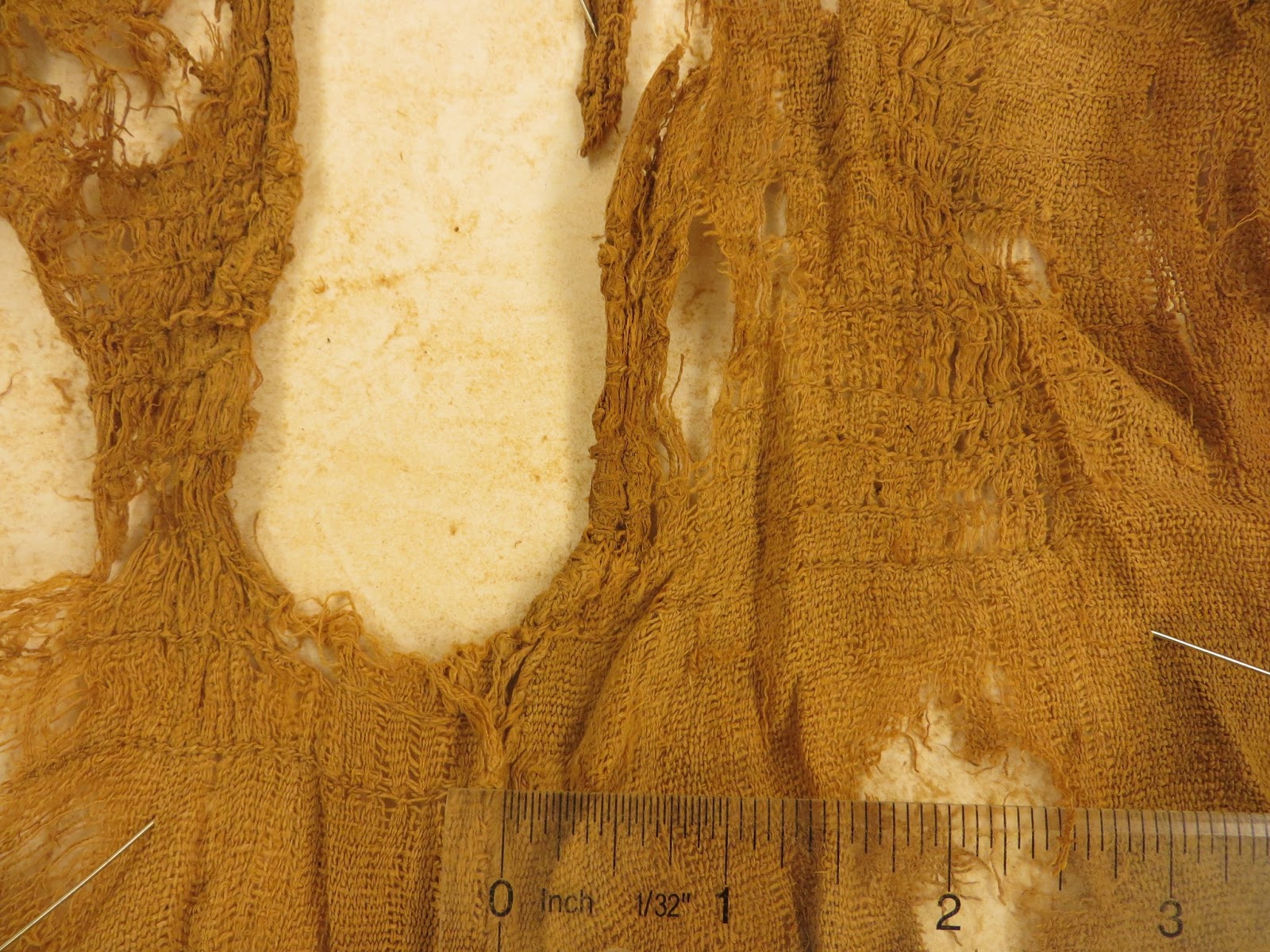
My friend and I went back to The Albany Institute of History and Art today to examine the textiles found under their mummies. We examined the two largest pieces. Both pieces are S spun warp and weft, and tabby weave. The first piece is a rectangle, with a selvedge edge. There is no way to know what its original purpose was, but it is a lovely piece of fabric.
 The blue/green warp threads are almost hidden by the weft, but enough color peeks through that it almost reminds me of modern 2-color fabrics. The selvedge edge is also decorative.
The second piece we examined was a piece of clothing. It is 59 inches long, and includes a seam and an armhole. The bottom edge is fringed. There is decorative stitching around the armhole.
 Isn't it beautiful? We have taken measurements and photographs. Now it is time to do more research!

The second piece we examined was a piece of clothing. It is 59 inches long, and includes a seam and an armhole. The bottom edge is fringed. There is decorative stitching around the armhole.
Wednesday, February 27, 2013
My S and Z Spinning Study
I've been busily working on my presentation for the conference in Kalamazoo, but I thought it would be nice include my documentation from my study on the blog. So, if you are interested, you can find it under Projects. You will need to look at both the words and the samples for it to make sense. Most of the photos do not show the pattern very clearly (real life is much better), but at least you might get an idea of what I was up to.
Monday, February 18, 2013
King's and Queen's Arts & Sciences Competition
Saturday was King's and Queen's A & S competition. I went to the event to support my apprentice sister who was being inducted into the Order of the Laurel. Of course that meant, to keep the surprise, I had to enter the event. So, I entered my spinning experiment.

It made such a plain display compared to the work of all the other amazingly talented entrants. But, as I discovered last year, it is great fun to get to talk to people about what you are passionate about (whether that happens to be thread or subtleties - you should have seen the amazing dragon!). I was lucky enough to have a table in the sunlight. The best thing of all was that as I began to explain what I was testing - the impact of spin direction on cloth design - even before I was done, people's face would light up and they would pick up a sample and say "oh, I can see it!"


This is Icelandic, my most obvious sample, but it was usually a white sample that people picked up.
As I worked on the project I had begun to wonder if the effect was really real, or if people beside me, or experienced weavers would also see the change between S and Z threads. It really made me happy when people whose expertise was pottery, or woodworking, or metalsmithing, could also pick up on the subtle change.
Unlike other years, the King and Queen narrowed the field down to 5 finalists with a wide range of talents, before choosing their champions.

In the end, I was chosen as this year's Queen's Champion. It is a great honor, which I hope I can live up to.

Friday, February 8, 2013
the S and Z spinning experiment
I have spun the wool of 6 different breeds and woven 10 samples to test the effects of S and Z spinning in fabric design. You may think that is excessive, but it was so much fun, I kept wanting to try another breed. I won't bore you with all the results. The Romney wool was the most successful. Whether the wool was carded or combed, dyed or natural, the plaid pattern is easily seen.
 The photos don't do it justice, but the slightly lighter stripes in this carded wool sample are the S threads.
 While there is a slight variation in the natural fiber color, the threads are actually quite uniform in color. The stripes are formed by the change between S and Z threads.
I will have to add weaving a larger, usable piece to my 2013 to-do list. I already know from my samples that the larger the piece is, the more noticeable the pattern is as the fabric shifts in the light.


I will have to add weaving a larger, usable piece to my 2013 to-do list. I already know from my samples that the larger the piece is, the more noticeable the pattern is as the fabric shifts in the light.
Subscribe to:
Posts (Atom)